
Understanding GFC hair treatment
GFC is a label used for growth-factor preparations, but a familiar abbreviation does not establish that every preparation has the same composition or supporting evidence. Ask what exactly will be prepared, how it is obtained and why that method is relevant to your diagnosis. The decision is particularly important when a treatment is marketed as an upgraded version of another injection. A higher price, a different kit or an additional processing step does not by itself prove a better clinical result.
Published GFC evidence now includes a small early pilot and newer comparative studies. These studies use particular preparations, selected patients and limited follow-up, so their findings should not be generalized to every treatment sold under the same name. Results also depend on the outcomes measured and accompanying care. GFC should therefore be discussed as an option with an evolving evidence base, not a standardized cure or an automatically superior version of PRP.
Could this be right for you?
Who it may suit
- People considering an injectable option after a hair-loss assessment.
- A specialist must decide whether the proposed preparation fits your diagnosis and medical history.
What your assessment should cover
- Ask which preparation and protocol are proposed, who performs the procedure and why it is suitable for you.
- Discuss previous hair-loss treatment, blood-related conditions, medicines and expectations.
How the care pathway works
Clarify the diagnosis
A treatment label alone does not establish why hair is thinning. Your assessment should lead the decision.
Understand the preparation
Ask how your blood is collected and processed, how the preparation differs from PRP, and what evidence supports that protocol.
Set a review point
Agree on progress documentation, the initial course and a decision point before further treatment.
Growth factors, follicles and product terminology
A hair follicle is a living structure below the scalp surface. The visible strand is the hair shaft it produces. Blood-derived growth-factor preparations are intended to influence the environment of existing follicles; they are not transplanted follicles or a replacement for an adequate donor supply. The phrase growth factor describes a type of biological signal, not a promise that a particular preparation will create a predictable amount of hair.
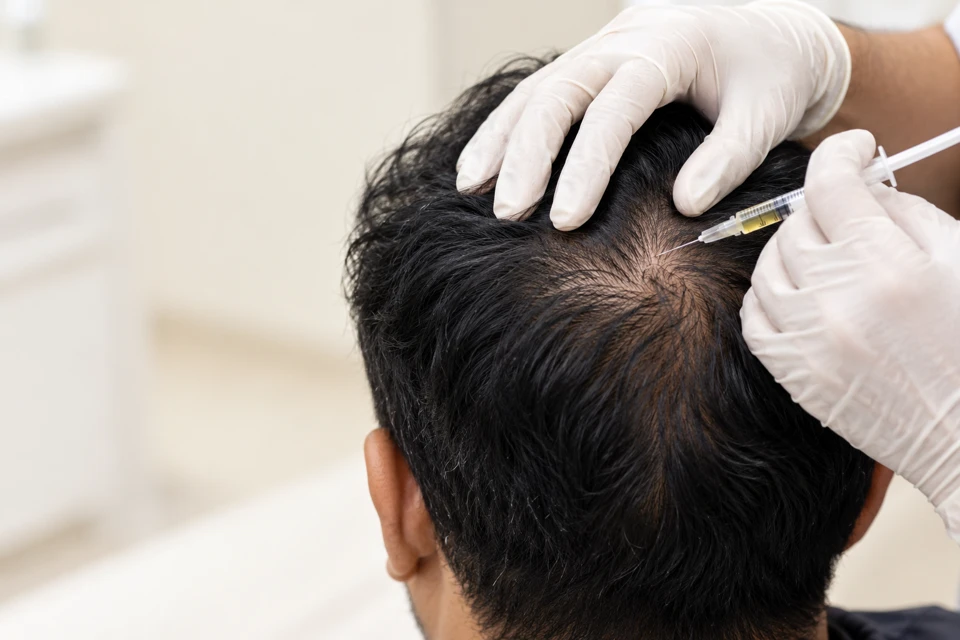
GFC preparation generally involves processing a person’s blood and activating platelets to obtain a growth-factor-containing preparation. The precise kit, processing method and contents matter. Terms used in research are not always interchangeable, so results for concentrated growth factors, platelet-rich plasma or another growth-factor product cannot simply be transferred to every service called GFC. The method proposed for you should be identifiable in the treatment record.
What the newer comparative studies can tell us
Evidence is broader than the early five-patient pilot. A published retrospective comparison included 42 people with male or female pattern hair loss. Its findings varied by the measure and time of assessment. Because treatment was not assigned in a randomized design, differences between the groups may influence the comparison. This is useful emerging evidence, not proof of a universal winner.
A later randomized study enrolled 44 people and compared GFC with PRP while both groups also used topical minoxidil. Forty completed follow-up. The authors reported similar improvements in the main hair measure and less injection pain in the GFC group, while acknowledging the small sample and short follow-up. These findings do not establish how GFC works alone, permanent benefit or superiority for every preparation and patient. They support a balanced discussion rather than a blanket upgrade claim.
Choosing a course with a clear purpose
Selection begins with a diagnosis and a review of treatment already being used. A temporary shedding episode, active scalp disease and long-standing pattern thinning may require different plans. If GFC is proposed as an addition, its intended role should be explained separately from the effects of accompanying medicines. A review can then consider tolerance, visible change and the burden of continuing, rather than simply counting completed sessions.
Costs in India should be compared using the whole proposed course: consultation, blood processing, treatment area, visits, follow-up and possible maintenance. A kit name or premium price is not evidence of greater effectiveness. Written terms should clarify what happens if a session is postponed or the clinician recommends reassessment. With an emerging evidence base, it is especially useful to agree on review criteria before buying further treatment.
The stages of your care
Assessment
Confirm the diagnosis, exact preparation and alternatives. Record other treatment being used so the results can be interpreted honestly.
Proposed course
The treating clinician sets the schedule and aftercare. A research protocol is not a universal appointment timetable or a guarantee.
Review before extending
Compare photographs, tolerability and practical benefit. Longer-term maintenance and durability remain questions to discuss rather than assume.
Preparing, and looking after yourself afterwards
Before your appointment
- Bring medication details and previous scalp reports if available.
- Request the clinic’s preparation instructions; do not independently stop medicines.
Aftercare and follow-up
- Get written scalp-care guidance and contact details for questions after injections.
- Attend the agreed review before extending the treatment course.
Risks and honest limits
- Available studies include small pilot and comparative studies with limited follow-up; they do not establish a reliable success rate for every patient or preparation.
- Do not assume GFC is universally better than PRP. Ask about injection risks, uncertain benefit and ongoing costs.
Questions to help you decide
Understand the evidence
Request an explanation of the evidence for the particular preparation being proposed, including how closely the studied patients resemble your situation. Useful questions concern the diagnosis studied, comparison treatment, follow-up duration and how improvement was measured. Before-and-after images can illustrate an individual experience, but do not reveal how many people failed to improve. A balanced recommendation should make it possible to choose a more established option or defer treatment without pressure.
Make the treatment choice explicit
The consultation should separate diagnosis from product selection. First establish whether you have thinning, shedding, a scalp disorder or a combination. Then discuss the available approaches and why GFC is being considered. Ask what the plan would be if you declined injections. This makes the alternatives concrete and helps you judge the value of a proposed course without relying on terms such as advanced, concentrated or next generation.
Set a clear review agreement
Document the area being treated, your main concern and the method for recording change. Agree when progress and tolerability will be discussed, what further treatment might involve and what would justify stopping. If you are also using prescribed hair-loss treatment, record that alongside the injections. An honest review considers the whole plan and its burden. It should not turn an uncertain response into an automatic recommendation to purchase a larger package.
Common questions about GFC hair treatment
Is GFC better than PRP?
Current comparative studies do not establish that GFC is universally better. Findings vary by outcome and time of review, and some studies include minoxidil in both groups. The specific preparation, diagnosis, tolerability and continuing cost all matter; a blanket superiority claim is not justified.
Does GFC guarantee regrowth?
No. Discuss the possibility of little or no visible improvement and what the next step would be.
What should my written plan include?
The preparation, treating professional, session proposal, risks, cost and how progress will be reviewed.
Can I book a GFC package before the diagnosis?
Start with an assessment. Ask for the treatment rationale, alternatives, likely follow-up needs and a written estimate before deciding. A clear diagnosis and an informed choice are more useful than securing a package whose suitability has not yet been established.
Sources and further reading
General patient information. Your treating clinician should confirm which advice applies to you.